🌍 CBAM 2027: From Estimates to Proof – What Exporters Need to Know

European factories pay for the carbon they emit. Factories elsewhere often don’t. The Carbon Border Adjustment Mechanism (CBAM) closes that gap by charging importers for the carbon released when certain goods were made, known as embedded emissions.

What’s covered: iron and steel, aluminium, cement, fertilizers, hydrogen and electricity.
Where: The EU’s CBAM is already live. The UK’s starts January 1, 2027.

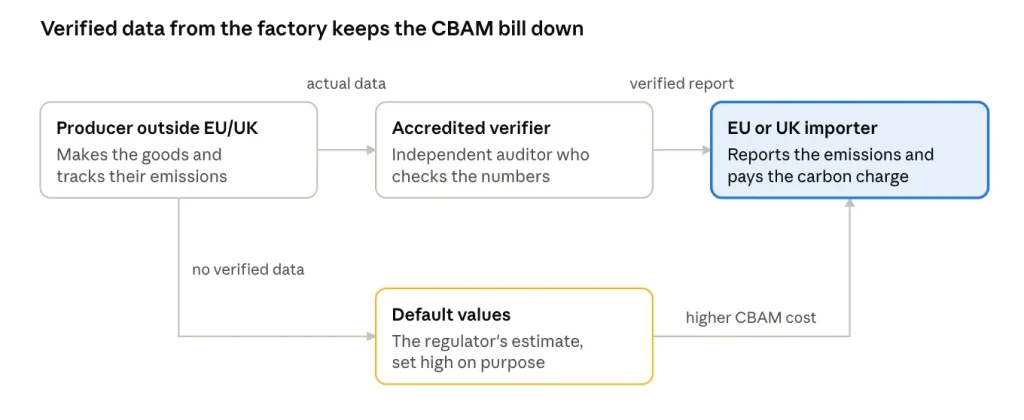
🔑 The one thing to know: The emissions data sits with the producer, but the bill goes to the importer. With no verified data, the importer must use default values: the regulator’s standard estimates, which are set high on purpose.
The Big Story: 2027 is when CBAM gets real

What happened
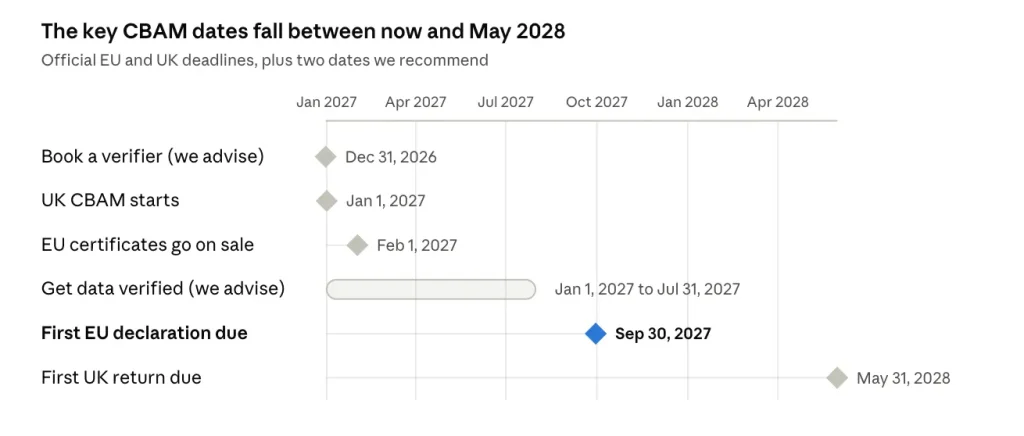
Since January 1, 2026, EU importers have owed a carbon charge on covered goods. The key dates coming up:

  • Feb 1, 2027: CBAM certificates go on sale

  • Jan 1, 2027: The UK CBAM starts

  • Sept 30, 2027: First annual declaration due (covering 2026 imports)

Why it matters
Each certificate covers one tonne of CO₂. The official price for Q2 2026 was €75.28. Proving lower emissions with verified data is the main way to cut the bill.

Who should pay attention

  • Producers in Canada, the US, Australia and Asia shipping covered goods to Europe: your customers will ask you for emissions data.

  • EU and UK importers: you carry the legal duty to report and pay

What we’d recommend
Start now. Independent verifiers only began work this autumn, and demand will peak in mid-2027.


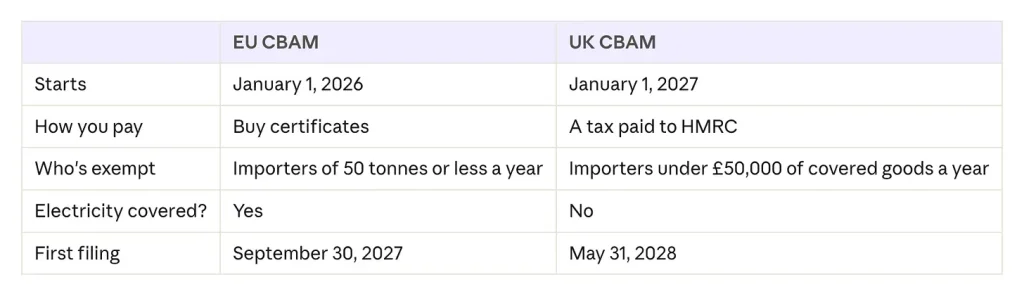
đŸ‡ȘđŸ‡ș 🇬🇧 EU vs UK at a glance

Same idea, different mechanics. If you ship to both, you’ll need to handle each separately.

No EU–UK exemption yet. Until the two carbon markets are linked, goods moving between them are treated like any other import.

Why the data matters: the cost of defaults

Default values carry a built-in penalty. For most goods, they’re marked up:

  • + 10% in 2026

  • + 20% in 2027

  • + 30% from 2028 (1% for fertilizers)

In 2026, free allowances also cancel most of the charge for a producer with good data. So on defaults, the penalty can end up being most of the bill.

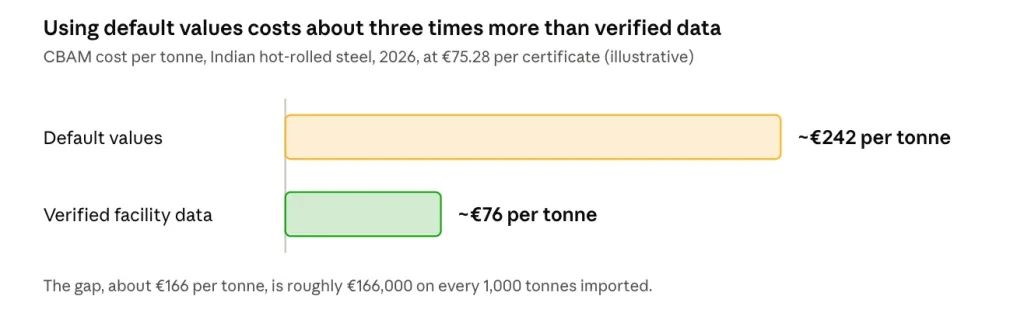
📊 Worked example: hot-rolled steel, 2026

That’s a gap of about €166 per tonne, and all of it comes from missing data.

🔍 How we calculated this:
CBAM cost per tonne = (emissions per tonne − free allocation adjustment) × certificate price

  1. Emissions per tonne. Defaults: 4.70 t CO₂, the EU default for Indian hot-rolled steel, including the 2026 mark-up. Verified: 2.34 t, worldsteel’s 2024 global average for blast-furnace steel.

  2. Free allocation adjustment. EU steelmakers still get 97.5% of their allowances free in 2026, so CBAM subtracts the same: benchmark × 97.5%. That’s 1.53 t × 97.5% = 1.49 t on defaults, and 1.37 t × 97.5% = 1.34 t with verified data.

  3. Certificate price. €75.28 per tonne of CO₂, the Commission’s official Q2 2026 price.

Your customers see this gap too. A supplier without verified data costs them more than one with it. Fastmarkets estimates defaults act like a tariff of more than 15% on hot-rolled steel.

Missing the deadline costs the same. If verification isn’t finished by September 30, 2027, the importer has to use defaults.

Not sure how your numbers compare to the default? Book a 15 minute chat here and we’ll walk through it with you!

Not sure how your numbers compare to the default?

Book a 15 minute chat here and we’ll walk through it with you!

🇹🇩 Canada’s hidden advantage: real numbers win

Canada is the most CBAM-exposed country in the world. That sounds like bad news, but it’s actually a business opportunity.

Many Canadian plants already run well below the EU’s defaults:

  • 🇹🇩 Canadian aluminium: about 60% below the CBAM default

  • đŸ‡ș🇾 US aluminium: about 20% below

That advantage only counts if you can prove it. The EU just made proof harder to skip: on August 14, it published 10 new guidance documents moving exporters from “estimate” to “prove it”. That means real data, monitoring plans and third-party verification. Without verified data, a low-carbon Canadian smelter is billed at the same worst-case default as a high-emitting one.

💡 This isn’t a sustainability ask. It’s a pricing lever.
The supplier who hands their EU buyer a verified, below-default number becomes the cheaper, lower-risk choice. Nothing else about the product has to change.

Hear more from our CEO. Sanders Lazier joined The Better Ideas Show by The Energy Mix. He explains why Canada’s clean aluminium and steel could win new markets under CBAM, but only if we can measure and prove it. He also covers why spend-based Scope 3 estimates can be way off, and why bad data now carries legal risk in Canada.

▶ Watch Sanders’ clip below!

🧭 Getting ready: five steps

  1. Check if you’re in scope. Match your products’ customs codes against the CBAM list, then compare your volumes with the EU and UK thresholds.

  2. Find the factories. For each covered product, note the plant that made it, not just the company that sold it.

  3. Ask for the data. Request emissions per tonne of product for 2026. The Commission’s free supplier template keeps everyone on the same format.

  4. Book a verifier. Only EU-accredited verifiers count. Aim to have one booked by the end of 2026.

  5. Keep proof of carbon costs already paid. If your producer already pays a carbon price at home, the importer may be able to deduct it.

Talking to suppliers? Start with three questions:

  1. Which plant made our goods?

  2. Have you heard of CBAM?

  3. Have you booked a verifier?

See it in action: how Tier 1 auto supplier Semblex answers its customers’ CBAM data requests here!

3 Things We’re Watching

01 | CBAM could reach finished products
The EU is weighing an expansion to about 180 steel- and aluminium-heavy products, such as parts and components. Parliament set its position in September, and talks with member states come next. Read more here.

02 | A gentler cost ramp
In July, the Commission proposed a slower phase-out of free allowances for CBAM sectors, ending in 2038. That would slow how fast CBAM costs rise. Learn more here.

03 | A trade challenge
On September 25, the WTO set up a panel to hear Russia’s complaint against the EU CBAM. It doesn’t pause any deadlines. Read more here.

More To Explore